Member Login

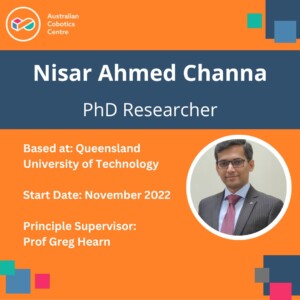
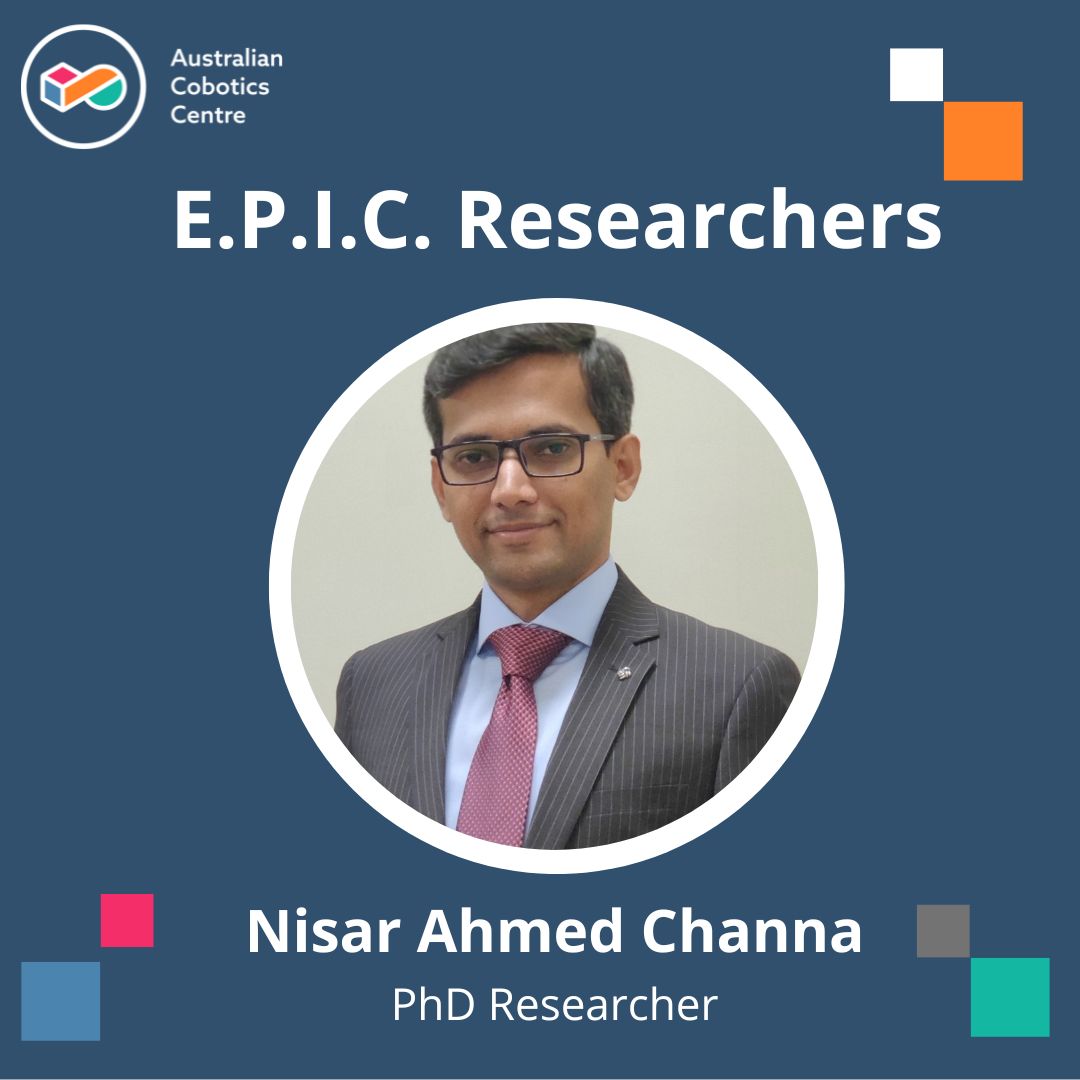
Meet our E.P.I.C. Researcher, Nisar Ahmed Channa

The Australian Cobotics Centre has some incredibly E.P.I.C. researchers. Each month we will be profiling a different researcher.

Nisar Ahmed Channa is a PhD Researcher in the Human-Robot Workforce research program at the Australian Cobotics Centre. His research interests lie primarily in the areas of technology and human resource management, industry 4.0, and organisational behaviour.

We interviewed Nisar recently to find out more about why he does what he does.

  • Tell us a bit about yourself and your research with the Centre?

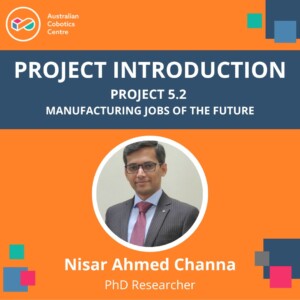
I am a PhD researcher working on program 5.2: Manufacturing jobs of the future. This program aims to explore current state of literature on Cobots-workforce nexus, challenges associated with adoption of Cobots for both human workers and manufacturing companies, and implications of Cobots for manufacturing companies. My research helps to address challenges associated with the adoption of Cobots in manufacturing and is of vital importance for both academics and policy makers for workforce policies and practices needed to manage human and non-human resources. Recently, we have completed two studies on the current state of industry, speculative, and commentary sources in addressing the impact of Cobots on future jobs and employment. As a result of this, we developed a framework which helps manufacturing companies to enhance their organizational capabilities to adopt Cobots. The outcomes of this program will pave the way for Cobots to supplement human workers in assembly lines.

  • Why did you decide to be a part of the Australian Cobotics Centre?

The main reason behind this was the fact that Australian Cobotics Centre provide me with an opportunity to work with prominent scholars in this area and to pursue my research interests in this field. Working with centre will also allow me to interact with the industry and to get firsthand knowledge about the workforce issues in manufacturing sector and to work on solutions to those issues. It will be an opportunity to contribute into an effort to enhance manufacturing capacity and increase Australia’s manufacturing potential.

  • What project are you most proud of throughout your career and why?

One of the projects on which I worked during my masters was on how organizations going through adversities and uncertainties caused by changes in external environments can bounce back from such situations and remain competitive by developing capacity of resilience through strategic alignment of resources. At that time, the industry was going through a variety of challenges caused by global economic crises. This was one of the initial attempts endeavoured by the academia to provide policy guidelines to industry and government on how to tackle such crises and to remain competitive. I am further expanding this work in my PhD and research I am doing with ACC.

  • What do you hope the long-term impact of your work will be?

The research I am doing with ACC will lead to address issues related with adoption of Cobots in manufacturing industry. To deal with issues related to unavailability of skilled workforce, manufacturing companies are automating their manufacturing processes and adopting Cobots to meet the unavailability of skilled workforce. However, the adoption of Cobots in manufacturing brings new challenges in form of resistance from employees and workforce policies and practices needed to manage human and non-human resources. I am optimistic that my work will help Australian manufacturing companies to address these challenges associated with adoption of Cobots.

  • Aside from your research, what topic could you give an hour-long presentation on with little to no preparation?

Apart from my current research at ACC, history is a topic which always fascinate me. I can easily present on topics like political history of South Asia for hours.
ARTICLE: 6 Reasons Why We Need a Prototyping Toolkit for Designing Human-Robot Collaboration

In this article, Postdoctoral Research Fellow, Stine Johansen and PhD Researcher, James Dwyer highlight the pressing need for a #prototyping toolkit to support the design process of human-robot collaboration (HRC).

As robots become increasingly integrated into industry, companies are grappling with uncertainties surrounding their implementation and task allocation. Developing a prototyping toolkit is one way to address these challenges.

By involving manufacturers and end-users early in the design process, we can harness their domain knowledge and tacit expertise to create meaningful outcomes to transform the future of manufacturing.

Read more HERE


PhD Project Introductions

Collaboration and information sharing across our research programs and disciplines is vital for our Centre’s success. To support this, we ask that all our PhD Researchers present a short project introduction within their first 6 months of starting their PhD.

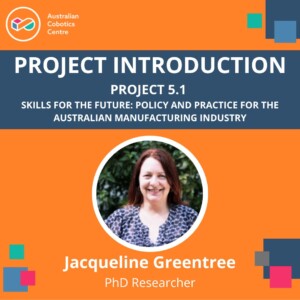
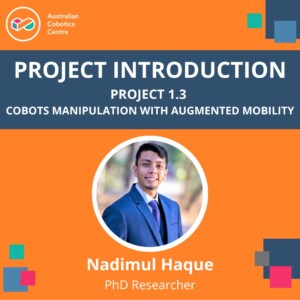
Earlier in the month, we heard from Jacqueline GreentreeNisar Ahmed Channa and Nadimul Haque. Each provided an overview of their project’s goals and objectives, proposed methodology, and expected outcomes. We will continue to share updates on their progress as their research continues. In the meantime, you can find out more about what they hope to achieve HERE


Meet our E.P.I.C. Researcher, Dr Alan Burden

The Australian Cobotics Centre has some incredibly E.P.I.C. researchers. Each month we will be profiling a different researcher.

Alan is a Postdoctoral Research Fellow in the Designing Socio-Technical Robotic Systems Program (Program 3). His research works to embed holistic design as a critical factor in creating a seamless integration of humans and machines working together. The aim of this is to improve human work conditions and environments, increase effectiveness and efficiencies in production, as well as workforce acceptance.

We interviewed Alan recently to find out more about why he does what he does.

  • Tell us a bit about yourself and your research with the Centre?

My background is in three areas – science, architecture, and in human factors design. I worked in all three industries, and I try to bring the experiences to my research. In the ACC, I research socio-technical systems – which focus on the connections between people, the technologies they use, their activities and the use of space. This area of research is growing rapidly along with other areas linked to cobotics. The long-term impact of my research will add to the knowledge and help forge a future direction for interactions between humans and robots, particularly within workspaces.

  • Why did you decide to be a part of the Australian Cobotics Centre?

The curiosity of new technology mainly. I wanted to work with a multidisciplinary team looking at areas I was also interested in exploring. I am interested in emerging technologies such as extended reality (XR) and the next generations of those technologies. Some of these technologies allow connections between our physical environments and the digital realm, with the digital realm becoming incredibly represented as a 3D world. These technologies aren’t just the domain of game design, computer science, or engineering – but increasingly a blend of all research disciplines. I think that’s why so many of us now collaborate with different researchers and industries from diverse fields – because the technology has the potential to impact all of us.

  • What project are you most proud of throughout your career and why?

I don’t dwell on many past projects, but some are memorable for a few reasons. I’ve done a few projects that could be considered interactive or artistic installations, and it was interesting to see how people engage with something you’ve designed – especially when it’s not the way you thought anyone would try. It’s always surprising and teaches you to squash any assumptions.

  • What do you hope the long-term impact of your work will be?

I hope my work will help the frameworks we need for cobotics. Particularly when bringing cobots into existing workplaces. That will be where most cobots will have the most impact in Australia. In the future, I also believe there is a capacity to research the effects that cobotics and energy technology will have on workplace architecture, human well-being, and user experience. Those are areas I’d like to be involved in going forward.

  • Aside from your research, what topic could you give an hour-long presentation on with little to no preparation?

Haha, probably a short list of things considered trivial or geeky. Anything technological, English Premier League, The Simpsons (the ‘golden era’ of seasons 2 to 10), Lord of the Rings or 80s movies. Closer to research, like data visualisation, and graphic design, and could talk about that for a bit.

ARTICLE: The Human Robot Workforce research program

To implement #collaborativerobotics effectively in #advancedmanufacturing, we must address the both the technological advancements required and the human and design factors that are associated with technological change. These areas form the focus of our research programs, each comprising several PhD projects that explore specific research questions.

Our Human Robot Workforce program is the first of our research programs where all of its PhD researchers have begun their projects. Today, we are delving a little deeper into the program and share the objectives of each project within it.

Program Leads: Dr Penny Williams & Prof greg hearn
Program Postdoctoral Research Fellow: Dr Melinda Laundon
PhD researchers: Jacqueline GreentreeNisar Ahmed ChannaAkash HettiarachchiPhuong Anh Tran
Other Chief Investigators involved: Dr Sean Gallagher
Associate Investigators Dr Claire Mason & Dr Luca Casali

Read more HERE


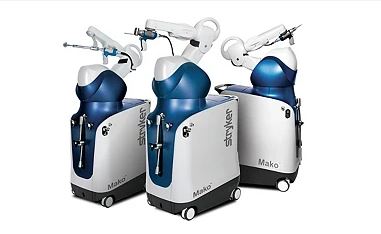
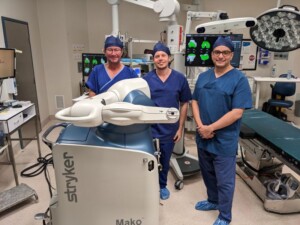
Stryker’s Mako robot in action

Earlier this week PhD Researcher, James Dwyer and Postdoctoral Research Fellow, Alan Burden got to observe a robotic knee surgery performed by Professor Ross Crawford.

It was a great opportunity for the pair to see Ross in action with Stryker‘s Mako robot. The robot assists in accurate preparation of the bone following balancing of the knee in an attempt to put the implants in the most suitable alignment.

Although this is not a manufacturing environment, there are many elements we can carry over, including:
– how the surgeon uses and adapts their movement to the robot;
– where it is positioned in the room in relation to the patient and surgeon;
– how the surgeon gets ‘feedback’ from the robot;
and so much more.

Thanks very much for allowing us into the operating theatre Ross!


CIRP Design 2023

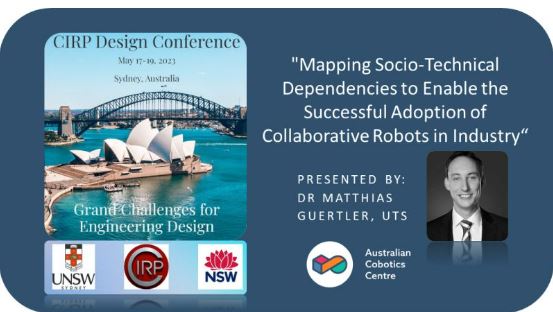
On Friday, 19 May, our ‘Designing Socio-Technical Robotic Systems’ research program Co-lead, Dr Matthias Guertler (from UTS Tech Lab) chaired a session and also presented a paper at CIRP Design 2023, hosted by UNSW.

The paper, authored by Matthias Guertler, Theodora Brackemann, Alan Burden and Glenda Caldwell, is entitled, “Mapping Socio-Technical Dependencies to Enable the Successful Adoption of Collaborative Robots in Industry”.

This work will contribute to helping companies in successfully choosing and embedding #cobots into their workplaces by better understanding how cobots and workplace interdepend.


Australian Research Council visit to ARM Hub

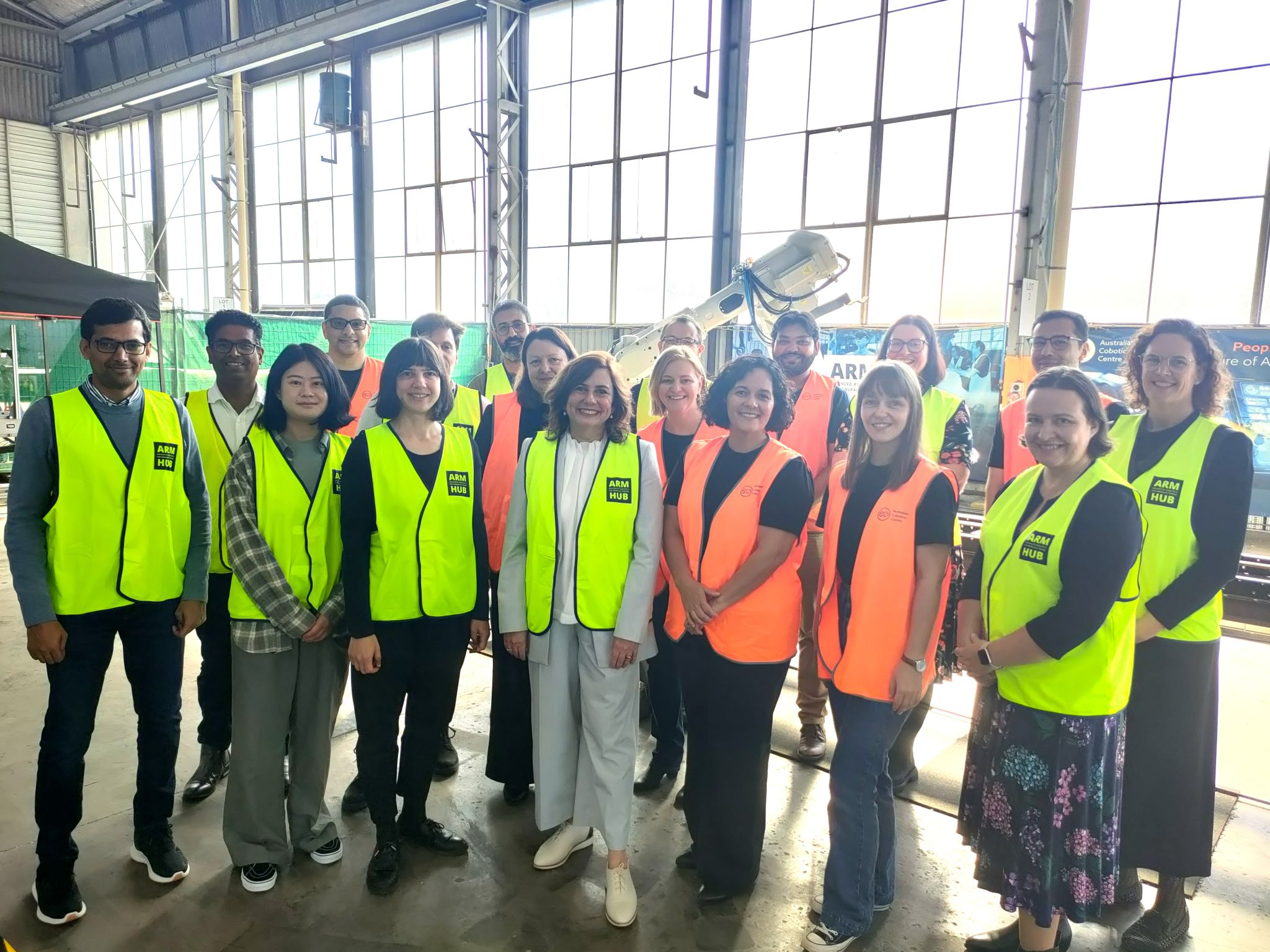
On Wednesday, 17 May, we were very lucky to have Australian Research Council Chief Research Officer, Professor Christina Twomey visit us at ARM Hub (Advanced Robotics for Manufacturing).

During the short visit, Research program co-Lead, Glenda Caldwell and ARM Hub (Advanced Robotics for Manufacturing) CEO, Cori Stewart talked about the Centre’s aims and how ARM Hub supports the translation of research into commercial outcomes for manufacturers.
QUT (Queensland University of Technology) researchers (postdoctoral research fellows (Melinda LaundonAlan Burden and Stine Johansen and PhD researcher, Barış Balcı ) then provided an overview and demonstrations of some of our recent projects with industry partners, including Cook MedicalB&R Enclosures and InfraBuild. There was even an opportunity to try out the #VR headset!

Thank you for visiting Professor Twomey, we would love to have you back again in the future!


Accelerate Manufacturing Conference, Dalby

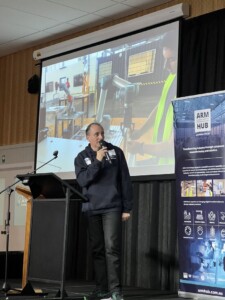
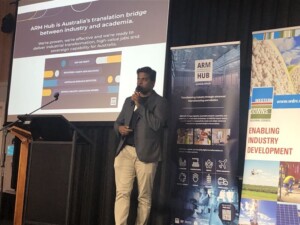
On Wednesday, 17 May, Centre Director Jonathan Roberts and ARM Hub (Advanced Robotics for Manufacturing)‘s Samuel Jesuadian were in Dalby for the 2023 Accelerate Manufacturing Conference.

The event, organised by the Western Downs Regional Council, provided attendees with the chance to discuss future and current opportunities facing the sector. Jon and Sam talked to the group of industry and government attendees about the opportunity to use advanced manufacturing and robotics to reduce industry waste ♻️. Cobotics offer manufacturers the potential to assist with labour shortages and have the added benefit of reducing waste!


Designing Shared Human-Robot Spaces – The Impact that Spatial Design Has on Socio-Technical Systems

Written by Dr Alan Burden, Postdoctoral Research Fellow from the Australian Cobotics Centre.

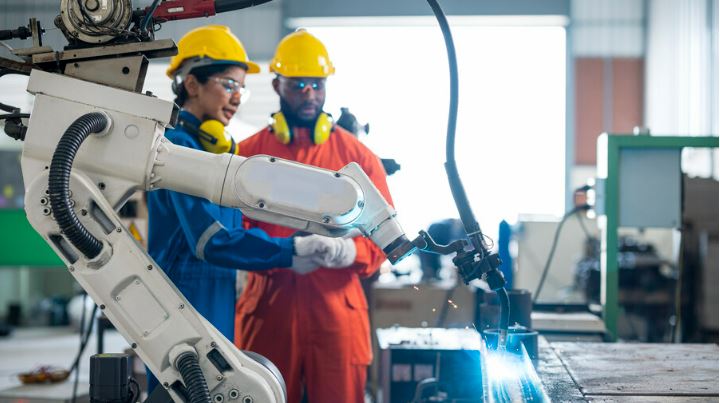
In the era of rapidly advancing technology, socio-technical systems (STS) are becoming increasingly relevant as they help integrate humans and technology in many different domains. One such example of an STS is cobotics which aims towards task collaboration between humans and collaborative robots, working together on tasks in a shared environment.

In a previous article (ambitiously titled A Very Brief Introduction to Socio-technical Systems), I wrote about how STSs aim to combine social and technical elements to create efficient, safe, and productive human-robot collaborations (HRC). In this article, we will look at shared environments, or to call them by another name, human-cobot co-working spaces – and the 5 key considerations that should aim for better STS outcomes.

While not a new concept in many industries, the idea of shared environments, particularly those inhabited by humans and machines, draws upon elements of architecture, interior architecture, industrial design, and interaction design. The interdisciplinary nature of shared environments is vital in creating functional spaces for human-machine interaction, including human-robot activities. This multidiscipline approach ensures that all aspects of the environment contribute to a successful STS. The overlap between these disciplines provides the foundation for optimising safety, productivity, and satisfaction within a shared human-robot workspace.

A common element across all areas of a cobotic STS are the spatial requirements, as crowded workspaces can significantly impact the human’s well-being (both mental and physical) while also severely limiting the cobot’s effectiveness. A well-designed space can improve safety, productivity, and worker satisfaction. In contrast, a poorly designed space may lead to inefficiencies and accidents. Consequently, organisations must focus on spatial design to ensure the seamless integration of humans and robots in the workspace.

Frequently in analysing and designing STSs, it makes sense to consider a holistic approach to address both human and robotic needs. This approach includes understanding the unique challenges (and opportunities) presented by shared human-robot spaces and developing strategies to overcome potential pitfalls. Organisations can craft environments that harness the positives of human-robot partnerships while ensuring safety and satisfaction for all involved by focusing on the key factors that influence successful collaboration. The factors that promote effective collaboration and maximise the benefits of STS are:

1.      Safety and Accessibility: Ensuring the safety of both humans and robots is paramount. Spaces should be designed to prevent accidents, with clear paths for movement, adequate lighting, and appropriate barriers or markings to delineate shared areas. Additionally, spaces should be accessible and ergonomic for human workers, accommodating their needs and abilities.

2.      Flexibility and Adaptability: As technology and work processes evolve, it’s essential to design spaces that can quickly adapt to new requirements. Flexible and modular workstations, reconfigurable layouts, and scalable infrastructure can help organisations accommodate changes in technology and work processes.

3.      Zoning and Separation: While human-cobot interaction might be the focus of STSs, there will be instances where separation is necessary for safety or efficiency reasons. Organisations should consider zoning and separating spaces for different tasks, allowing for focused work and minimising distractions or hazards.

4.      Communication and Visibility: Effective communication between humans and robots is critical for successful collaboration. Spaces should facilitate clear lines of sight, allowing visual communication and awareness of each other’s actions. Integrating multi-modal communication technologies like screens, speakers, and sensors can enhance information sharing and collaboration.

5.      Comfort and Aesthetics: Creating a comfortable and aesthetically pleasing environment can significantly impact worker satisfaction and well-being. Natural light, greenery, and comfortable furniture can create a more pleasant and supportive workspace.

Implementing shared human-robot spaces often substantially improves productivity, safety, and worker satisfaction. For example, a manufacturing facility that integrates cobots on the assembly line may create zones where humans and robots work together on specific tasks, with clear visual cues and safety barriers to prevent accidents. In healthcare, a hospital may design a shared operating room with robotic surgical assistants, with ample space for human surgeons to navigate and interact with the robotic systems.

As technology advances and human-robot collaboration becomes more commonplace, the importance of spatial design in STS will only grow. Organisations should prioritise spatial design as a critical aspect of their STS strategy, ensuring that shared human-robot spaces are safe, functional, and adaptable. Researchers, designers, and engineers must also develop new design principles and best practices to accommodate the evolving nature of human-robot interactions.

Overall, the success of HRC in STSs relies heavily on thoughtful spatial design. By considering safety, accessibility, flexibility, adaptability, zoning, communication, and aesthetics, organisations can create effective shared spaces that promote seamless integration between humans and robots. Developing new design principles and best practices that adapt to the evolving nature of human-robot interactions is crucial. Organisations that invest in well-designed shared spaces will undoubtedly reap the benefits of increased productivity, safety, and worker satisfaction. Embracing the importance of spatial design in STS is a vital step towards a harmonious and efficient future for human-robot collaboration.