Member Login

A Cost-Effective Path to Better Finishing: Robots That Learn Through Sound

Industrial automation has traditionally been built around a fundamental limitation: robots cannot “feel”. Sensing physical interaction with a workpiece or environment has historically required expensive hardware, making such capabilities impractical for many industrial systems. As a result, conventional industrial robots typically operate in isolation, executing preprogrammed motions without direct awareness of the forces they encounter. 

The development of collaborative robots (cobots) introduced the ability to sense internal forces and detect collisions, allowing for safer human-robot interaction. However, true physical awareness requires external sensors. When equipped with exteroceptive sensors, such as those that measure forces or vibrations, robots can respond to external conditions like a changing workpiece. This capability expands robotic automation into applications that require both force sensitivity and precision, including complex finishing operations such as grinding and polishing. 

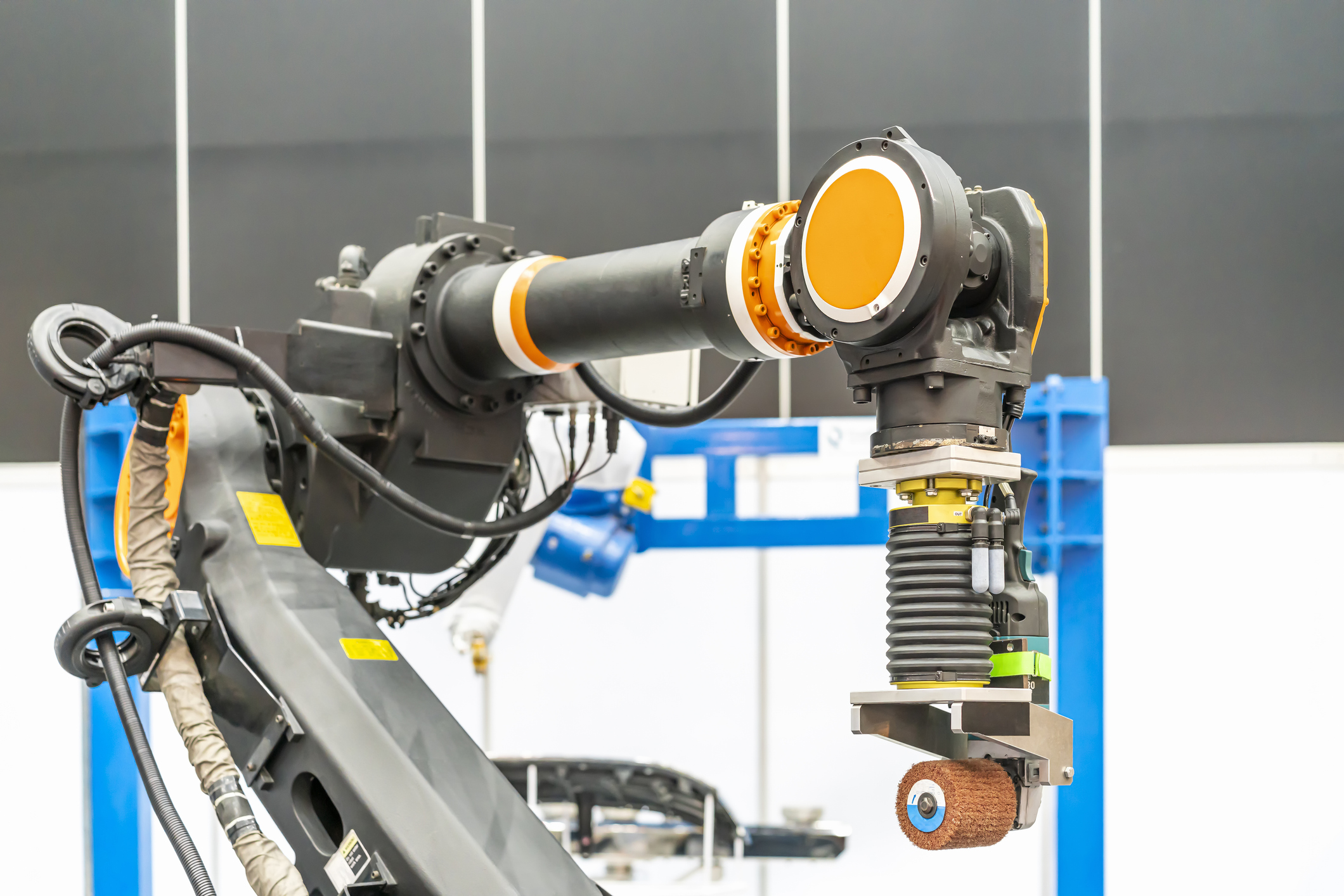
Grinding remains one of the most physically demanding tasks in metal fabrication. The process requires a balance between force and precision; too little pressure slows production, while too much risks damaging the part or wearing down the tool prematurely. These characteristics make grinding a promising candidate for automation. Many manufacturers pursue robotic grinding not only to address rising labour costs and workforce shortages, but also to achieve process consistency and repeatability. 

However, implementing robotic grinding typically requires high-end sensing hardware. These systems often rely on force/torque sensors to measure the interaction between the tool and the workpiece, enabling robots to maintain the controlled force necessary for precision finishing. These sensors can cost upwards of $4,400 USD. For many small and medium-sized enterprises (SMEs), particularly in Australia, this cost represents a significant barrier to entry, turning automation into a financial hurdle rather than a competitive advantage. 

Recent research by PhD candidate, Zongyuan Zhang and his supervisory team suggests that robots may not need expensive sensors to achieve force awareness. Human operators performing grinding tasks often rely on subtle auditory cues, like the pitch and vibration of the tool, to judge the quality of contact with the material. Experienced machinists can detect changes in force or tool wear simply by listening to the sound of the process. Inspired by this intuition, researchers have begun exploring whether similar information can be extracted using low-cost acoustic sensing combined with machine learning. 

The proposed Acoustic Feedback Robotic Grinding (AFRG) system (see Figure 1) demonstrates how this approach can work in practice. Instead of measuring force directly, the system monitors the acoustic signature of the grinding process. A single contact microphone is mounted to the tool bracket, capturing vibrations transmitted through the structure of the tool while filtering out much of the ambient noise present on a factory floor. 

The captured signal is processed by a specialised neural network known as PSDRegNet, a two-dimensional convolutional neural network designed to estimate the grinding force. By learning the complex relationship between acoustic patterns and grinding forces, the model can estimate the interaction force in real time. This data can then be used to adjust the robot’s behaviour online. Since the system learns this relationship directly from data, it avoids the need for rigid mathematical models that would typically govern robotic finishing processes. This flexibility allows the same system to adapt more easily to different materials, tools, and process conditions, reducing the time and engineering effort required to reconfigure robotic cells for new tasks. 

Another challenge in robotic finishing is tool degradation. As grinding discs wear down or become clogged with material, their cutting efficiency declines. Robots that rely on fixed paths or constant force setpoints often struggle to compensate for this change, leading to inconsistent material removal over time. In experimental trials conducted on hardened stainless steel, a material known for accelerating tool wear, the AFRG system demonstrated a fourfold improvement in grinding consistency compared to traditional force-based control. Since the acoustic model captures tangential force information closely related to the material removal rate, the system can maintain a stable finishing process even as the physical properties of the grinding disc change. 
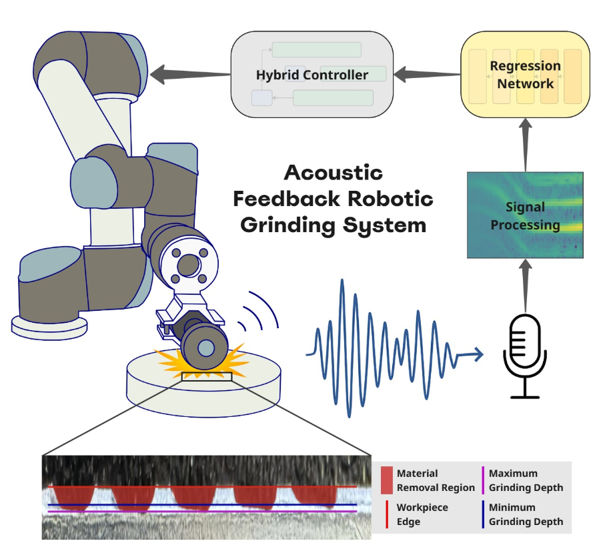
Figure 1: The Acoustic Feedback Robotic Grinding System (AFRG) leverages acoustic signals for closed-loop force control in robotic grinding. Rather than relying on costly force sensors, AFRG uses a low-cost contact microphone to estimate the grinding force. The process involves recording audio, processing the signals, and applying regression techniques to estimate the force, which is then used to regulate the grinding process. Image courtesy of https://arxiv.org/html/2602.20596  

The implications extend beyond grinding. If meaningful process information can be extracted from inexpensive sensors such as microphones, accelerometers, or cameras, machine learning may enable a new generation of low-cost perceptual capabilities for industrial robots. Instead of relying on specialised hardware for every sensing task, robots could infer key physical variables from readily available signals. 

For the Australian Cobotics Centre, this approach demonstrates a cost-effective pathway for quickly upgrading existing industrial infrastructure, something important for many Australian SMEs. Many legacy robots are position-controlled, following a set of predefined positions without sensing the forces involved in the task. Retrofitting these systems with force sensors can be costly, but in contrast, an acoustic sensing system can be integrated with minimal modifications, offering closed-loop force control at a fraction of the cost. 

More broadly, this work challenges the assumption that precision automation must rely on expensive hardware. By combining off-the-shelf sensors with machine learning, it becomes possible to convert robots from pre-programmed machines into adaptive systems capable of responding to their environment. 


Acoustic Feedback for Closed-Loop Force Control in Robotic Grinding, Zongyuan Zhang*, Christopher Lehnert, Will Browne, Jonathan Roberts 

CHI 2026 Honourable Mention for Human–Robot Collaboration Research

A paper from our Designing Socio-Technical Robotics Systems program has been recognised with an Honourable Mention Award at ACM CHI 2026, placing it in the top 5% of accepted papers at the world’s leading conference in human–computer interaction.

Titled “The Choreography of Care: An Ethnographic Study of Human‑Robot Collaboration in Makoplasty Surgeries,” the paper was recognised by the CHI Awards Committee for its originality, methodological rigour, and potential impact. The research offers in‑depth insights into how humans and robots coordinate care in surgical settings, contributing to critical conversations in human–robot interaction and healthcare technology.

The paper will be presented at CHI in Barcelona on 17th April.

Congratulations to Jasper Vermeulen and all co‑authors (James Dwyer, Alan Burden, Glenda Caldwell, Müge Belek Fialho Teixeira, Matthias Guertler& Ross Crawford) on this outstanding recognition.

Why “One-Size-Fits-All” DEI Strategies Don’t Work in Australian Manufacturing

Written by: Akash Hettiarachchi, Melinda Laundon, Penny Williams and Greg Hearn, all based at QUT in the Australian Cobotics Centre’s Human‑Robot Workforce program

International Women’s Day is an opportunity to celebrate progress toward gender equity and to reflect on persistent structural challenges in the workplaces. While many sectors highlight successes in advancing gender diversity, Australian manufacturing continues to struggle with its historically male-dominated image. Gender inequality in manufacturing is widely recognised. Yet the sector often progresses with uniform policies and strategies.

Our recent research, published in Equality, Diversity and Inclusion: An International Journal, challenges this approach by revealing that diversity patterns across manufacturing are far more complex, uneven, and sub-sector specific. This study examines workforce diversity across Australian manufacturing using Australian Census data from 2006 to 2021. By analysing trends in gender, generation, ethnicity, disability and educational qualifications across manufacturing sub-sectors, we show why improving gender equity requires targeted, context-specific strategies rather than generic, sector-wide approaches.

Manufacturing Gender Diversity is Uneven and Complex

Australian manufacturing is often described as male-dominated; however, our analysis reveals significant variations in workforce gender diversity across its sub-sectors. The overall representation of women differs considerably among sub-sectors such as food and beverage manufacturing, machinery and equipment manufacturing, and fabricated metal products. This unevenness raises questions about the success of gender-specific diversity strategies and outcomes in Australian manufacturing. Given the diversity composition differences among sub-sectors, broad, blanket gender diversity strategies are unlikely to be effective. Instead, improving gender equity requires a clear understanding of where women are over-represented, under-represented, or entirely absent. It also requires an understanding of how personal, structural, and occupational patterns differ across various manufacturing sub sector contexts.

True Representation is More than Increasing Participation

One of the key findings from our study is that improving gender equity is not simply about increasing the overall number of women in manufacturing. Women are frequently concentrated in specific roles and occupational categories, with limited representation across many technical and operational jobs on the production floor, compared with administrative functions. A focus on numbers alone does not deliver sustainable or meaningful representation in most needed job roles in operations.

These patterns suggest that recruitment focused strategies, while important, are insufficient. Genuine progress requires deeper organisational attention including job design, skills development, promotion pathways, and workplace cultures that support retention and advancement for equal opportunities of all genders. Gender equity in manufacturing is therefore closely tied to how work is organised and how careers are structured, particularly as roles continue to evolve through automation and digitalisation.

Different Generations and Future Skills

Our research highlights a persistent structural challenge within Australian manufacturing: the significant representation of an ageing workforce, alongside ongoing difficulty in attracting younger workers (particularly young women) into manufacturing careers. Despite numerous government initiatives, this imbalance remains largely unchanged.

Older workers continue to play a vital role, contributing critical operational knowledge, continuity, and deep technical expertise. At the same time, long-term workforce sustainability depends on successfully attracting and integrating younger talent. Compared with other sectors, manufacturing has been less successful in renewing its workforce, creating a growing concern for future labour supply.

These demographic dynamics intersect directly with technological change. As Industry 4.0 technologies, including collaborative robots, reshape manufacturing work, new skill demands emerge, often accompanied by workforce adjustment challenges. In response, some organisations must prioritise reskilling existing employees, while others may need to rethink job design and career pathways to better align with evolving technologies and the expectations of a more diverse future workforce.

From a gender equity perspective, this underscores the importance of expanding access — not only to employment, but also to training, reskilling, and progression opportunities. Without deliberate intervention, technological transformation risks reinforcing existing gender patterns rather than enabling more inclusive manufacturing careers.

Why This Matters for Cobotics and The Future Of Work

From the perspective of the Australian Cobotics Centre’s Human‑Robot Workforce research program, these findings reinforce that workforce diversity is central to successful technology adoption. Collaborative robots are introduced into existing workplaces shaped by workforce demographics, skills and organisational practices.

Manufacturing sub‑sectors with different gender profiles and labour market conditions will experience cobot adoption in different ways. Without inclusive workforce strategies, new technologies risk reproducing existing inequalities. Conversely, when job design and skill development are approached with gender equity in mind, collaborative robotics can support safer, more sustainable and more attractive manufacturing work.

Turning Reflection into Sustained Action

International Women’s Day is a useful moment for reflection, but our research highlights the need for ongoing, evidence‑based action. Gender inequality in manufacturing is well recognised, yet it is often oversimplified. Addressing it requires sub‑sector‑specific strategies informed by data and grounded in the realities of different manufacturing contexts.

At the Australian Cobotics Centre Human-Robot Workforce Research Program, this research informs our work on future skills, job design and workforce readiness. Improving gender equity is not separate from productivity or innovation. Rather, it is integral to building a manufacturing workforce capable of adapting to technological change and supporting the long‑term sustainability of Australian industry.


Prototyping Possibility: UTS Students Put the Kinematic Puppet to the Test

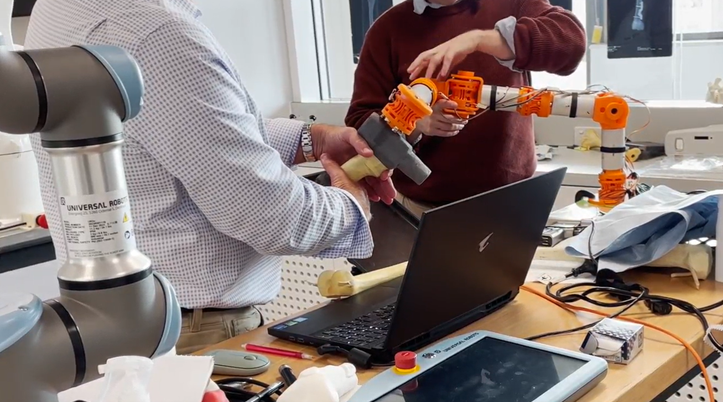
In Spring 2025, undergraduate engineering students from the University of Technology Sydney (UTS) partnered with the Australian Cobotics Centre (ACC) to explore an innovative prototyping method for human–robot interaction (HRI). As part of the subject 43019 Design in Mechanical and Mechatronic Systems, student teams built and tested the Kinematic Puppet—a low‑cost, modular robot‑skeleton prototyping tool designed to support rapid experimentation with robot morphology, motion and collaborative behaviour.

The puppet’s design combines 3D‑printed joints with magnetic rotary encoders and PVC linkages, giving users a physically manipulable platform for exploring robot movement and interaction in a way that is accessible, intuitive, and adaptable. The motivation for the kinematic puppet was discussed in a previous ACC article.

Building Capability Through Hands‑On Prototyping

The project offered students rich, applied learning opportunities across mechanical engineering, mechatronics, electronics, CAD, and hands‑on fabrication. Assembling the puppet from provided design files required teams to engage deeply with mechanical design principles while developing practical manufacturing skills. Students then used the puppet to prototype real HRI scenarios, experimenting with robot behaviours, designing custom end‑effectors, and capturing motion data based on their task concepts.

Beyond construction, students were asked to use the puppet to prototype HRI scenarios relevant to ACC partners. This shifted the learning experience from purely technical engineering to a more integrated design research mindset. Teams were encouraged to roleplay interactions, test alternative geometries, capture movement data, and reflect on usability. The result was a deeper understanding of how cobot systems behave not just as mechanisms, but as partners in real work environments research mindset. Teams were encouraged to role play interactions, test alternative geometries, capture movement data, and reflect on usability. The result was a deeper understanding of how cobot systems behave not just as mechanisms, but as partners in real work environments.

Real Benefits for the Australian Cobotics Centre

For the ACC, the project delivered meaningful insight into how the Kinematic Puppet performs as an early‑stage cobot‑prototyping tool. Students worked with the puppet across a variety of task types and skill levels, generating feedback on build complexity, robustness, adaptability, and user experience. This diversity of testing environments and techniques offered the Centre a broad evidence base for understanding the puppet’s value and limitations in practical prototyping settings.

The partnership also produced a range of custom tool attachments, demonstration artefacts, and user reports, helping the ACC shape future iterations of the puppet and refine research questions around embodied prototyping for collaborative robotics. These outputs contribute directly to a forthcoming study on the prototyping tools effectiveness as a design and ideation tool for industry‑relevant cobot applications.

A Model for Meaningful Industry–University Collaboration

The Kinematic Puppet project exemplifies the mutual benefits of embedding authentic industry challenges within university engineering curricula. Students gained hands‑on technical experience, confidence in iterative prototyping, and exposure to real‑world HRI design practices. Meanwhile, the Australian Cobotics Centre accessed high‑value feedback, creative exploration, and a new understanding of how early‑stage tools can support collaborative robot development.

By bringing students into the research process, this project created space for innovation, fresh ideas, and critical evaluation, laying groundwork for future cobot systems that are safer, more intuitive, and more attuned to human needs.

I would like to thank the students for their hard work on this impressive project; Lachlan Scott Rogers, Laila Chamma, Mishoura Rahman, Nicholas Uremovic and Tran Thu Nhan Dang. A video summarising the journey of the students can be seen here: Kinematic puppet for cobot prototyping