Member Login

Prof Glenda Caldwell Featured in AMTIL: Industry 5.0 and the Future of Collaborative Robotics

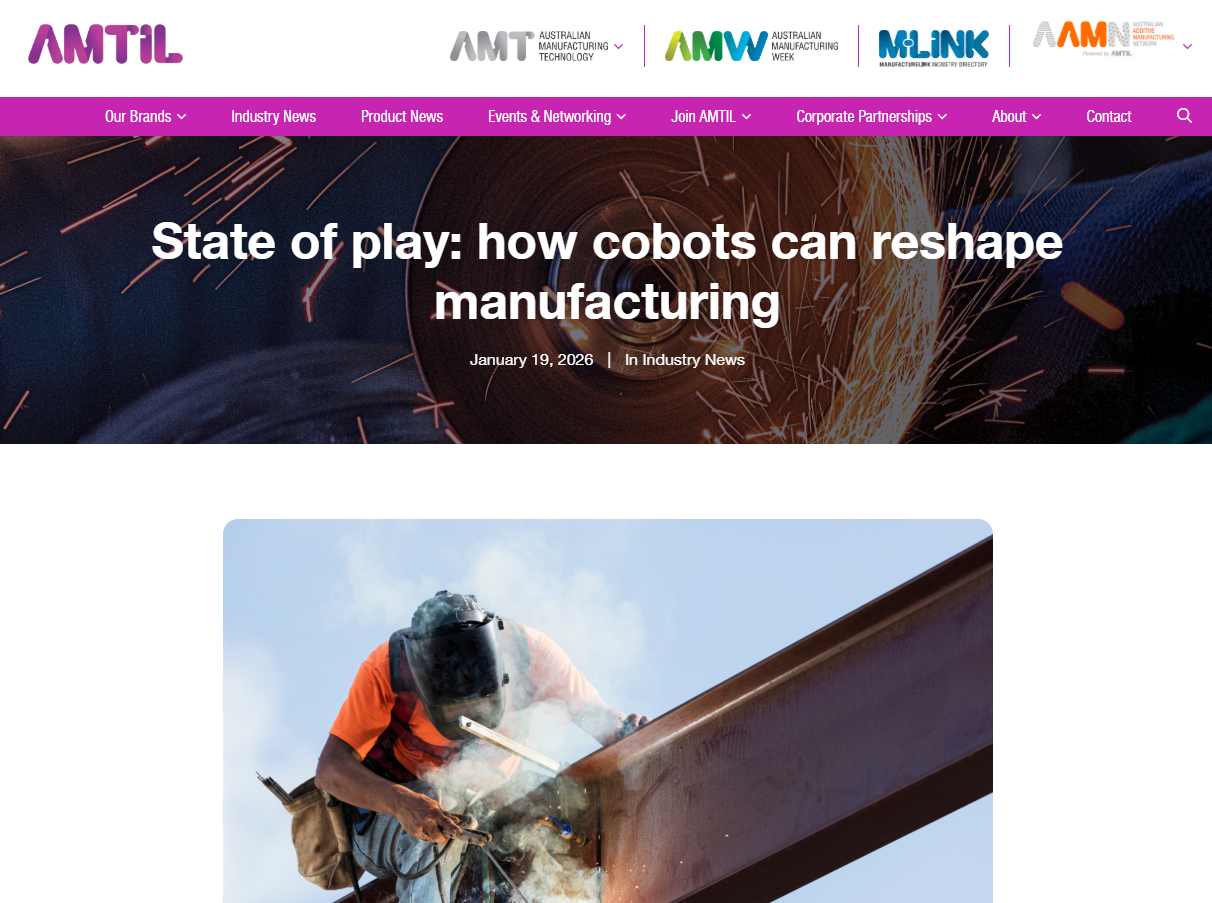
Deputy Director of the Australian Cobotics Centre & QUT Professor, Professor Glenda Caldwell, has been prominently featured in a recent AMTIL article exploring how Industry 5.0 is reshaping Australia’s manufacturing landscape. The piece highlights the growing importance of cobots as industry shifts toward more human‑centred, sustainable, and adaptable production systems.

In the article, Prof Caldwell explains that while Industry 4.0 focused heavily on technological advancement, Industry 5.0 calls for a deeper understanding of the human element—placing people, their needs, and their expertise at the centre of technology design and deployment. She emphasises that effective cobot integration begins with understanding the tasks workers perform, the environment they operate in, and the challenges they face.

The AMTIL article also notes the advantages of cobots, including built‑in safety sensors and the ability to work alongside people without traditional industrial barriers, making them more accessible to Australian manufacturers of all scales. Industry experts, including Weld Australia’s Dr Cornelius van Niekerk, reinforce how these features reduce infrastructure requirements while enhancing workplace safety.

Read more:
👉 AMTIL Article

Weld Connect Article

The latest Weld Connect magazine features our cobot welding project, led by Mariadas Capsran Roshan and the team at Swinburne University of Technology.

The article explores how collaborative robotic welding systems can use adaptive control and real-time sensing to improve weld quality, reduce defects, and make welding processes smarter and more efficient.

Check out the full article on page 14 here: Weld Connect – Weld Australia

IEEE International Conference on Robotics and Biomimetics (ROBIO) 2025

PhD Researchers, Jagannatha Pyaraka and Danial Rizvi presented papers at ROBIO 2025, the IEEE International Conference on Robotics and Biomimetics, which took place in China from 3–7 December.

  • Real-Time Human-Object Interaction Recognition Using Minimal Keypoints and Bi-LSTM for Imitation Learning,  Jagannatha Charjee Pyaraka, Mats Isaksson, John McCormick, (Swinburne University of Technology) Fouad Sukkar, and Sheila Sutjipto (UTS Robotics Institute)
  • Toward Plug-and-Play Asset Management: Spot-Based Visual Surveying in Untagged Industrial Spaces, Danial Rizvi, Gavin Paul, Amal Gunatilake, (University of Technology Sydney) and Mariadas Capsran Roshan (Swinburne University of Technology)

Giving cobots the human touch through biomimicry

This is article written by Robyn Barden from UTS and originally published via the UTS website Giving cobots the human touch through biomimicry | University of Technology Sydney (uts.edu.au)

An Australian Cobotics Centre roboticist is raising awareness of collaborative robots and biomimic research in a mechatronic musical installation where the lead percussionist is a collaborative robot.

Dr Fred Sukkar stands outside the shopfront next to the mechatronic music ensemble
Dr Fred Sukkar (right) is developing algorithms to enable natural and safe human-robot collaborative environments in the manufacturing industry at the Australian Cobotics Centre (ACC). Pictured at the centre of the musical ensemble is a collaborative robot (cobot) holding a caxixi, flanked by six mechanised drums.


UTS robotics researcher, Dr Fred Sukkar, has taken his research out of the lab and onto the streets with a robotic percussion ensemble display in Sydney’s CBD, a collaborative installation with the University of Technology Sydney, Australian Cobotics Centre, Macquarie University and Aesop Sydney.

Based in Aesop Sydney store, the installation with an industrial edge responds autonomously to music played in the store.

Six mechanical drums play along to music while the leader of the ensemble, a collaborative robot (cobot), shakes a basket-woven caxixi or ‘dances’ to the beat.

“When the store plays music the system listens and extracts information, such as the rhythm and tempo, then the ensemble plays along in an interactive way to compliment the music,” said Dr Sukkar, an Australian Cobotics Centre postdoctoral research fellow based at the UTS Robotics Institute.

For the cobot to learn how to play the caxixi, Dr Sukkar used motion capture cameras and reflective markers to record a human percussionist, then the robot replicates this movement.

“My biomimic cobots research aims to transfer skills to robots through human demonstration,” he said.

“The idea of translating human motion to a cobot is useful in our industry projects for intuitively teaching new skills and ultimately integrating cobots more naturally into workplaces.” Dr Sukkar said, the mechanised ensemble was conceptualised and constructed by Dr Richard Savery, a developer of artificial intelligence and robotics and research fellow  at Macquarie University.

“Richard combines music with robotics in a creative way to evoke human emotion.”

The cobotic musical installation was at the Aesop Sydney store, located in Pitt St Mall and was on display for 3 weeks until 19 November 2023.

The Australian “The rise of AI is shaking up the world of work”, Dr Penny Williams

Research Program Lead Dr Penny Williams featured in The Australian today in an article entitled, “The rise of AI is shaking up the world of work”, part of the Women in Education, Cutting Edge Careers special edition.

Penny talked about her research with the Australian Cobotics Centre and the opportunities available for women working with AI and robots in the future. “Women should consider courses that, in addition to giving them a trade or professional qualification, will help them develop digital skills, including basic coding. (They’ll also require) entrepreneurial thinking, strong communication and problem-solving skills, and the ability to collaborate with both humans and machines.”

Read the full article: https://lnkd.in/gGjv_zen

Weld Australia Magazine – Members survey

In early 2022, the Australian Cobotics Centre conducted a survey of Weld Australia members about their workforce and technology challenges. This feedback is crucial for us to understand how we can support the welding industry as it is a key driver and enabler of advanced manufacturing.
Tasks that Weld Australia members identified as potentially suitable for cobots included grinding, overhead welding, repetitive welding, and manual handling. The key challenge relating to the workforce was seen as labour shortages and skills shortages. A wide range of critical job roles were identified, with welding highlighted as the most critical. Other critical roles included managers, project managers, supervisors, trainers, and staff with knowledge of welding standards and health and safety standards.

For more information, see the June 2022 issue of Australian Welding: Australian Welding – June 2022 – Cobotics Centre V2