Member Login

The Association of Industrial Relations Academics of Australia and New Zealand (AIRAANZ) conference

Our Human-Robot Workforce researchers, Associate Professor Penny Williams and Professor Paula McDonald were at The Association of Industrial Relations Academics of Australia and New Zealand (AIRAANZ) conference at the University of Technology Sydney from 28-30th January.

Penny presented in multiple sessions including one in the ‘Technology and Worker Voice’ stream: Humanoids at Work: What will happen when workplaces are shared with human-like robots? by Melinda Laundon, Penny Williams.

The theme of this year’s conference is Shifting perspective and practice: Industrial relations in a changing world of work.  This theme invites reflection and dialogue on societal impact in industrial relations scholarship and practice, and the challenges and opportunities of undertaking socially impactful research in a changing world of work.

Read more: AIRAANZ conference 2026 | AIRAANZ
Prof Glenda Caldwell Featured in AMTIL: Industry 5.0 and the Future of Collaborative Robotics

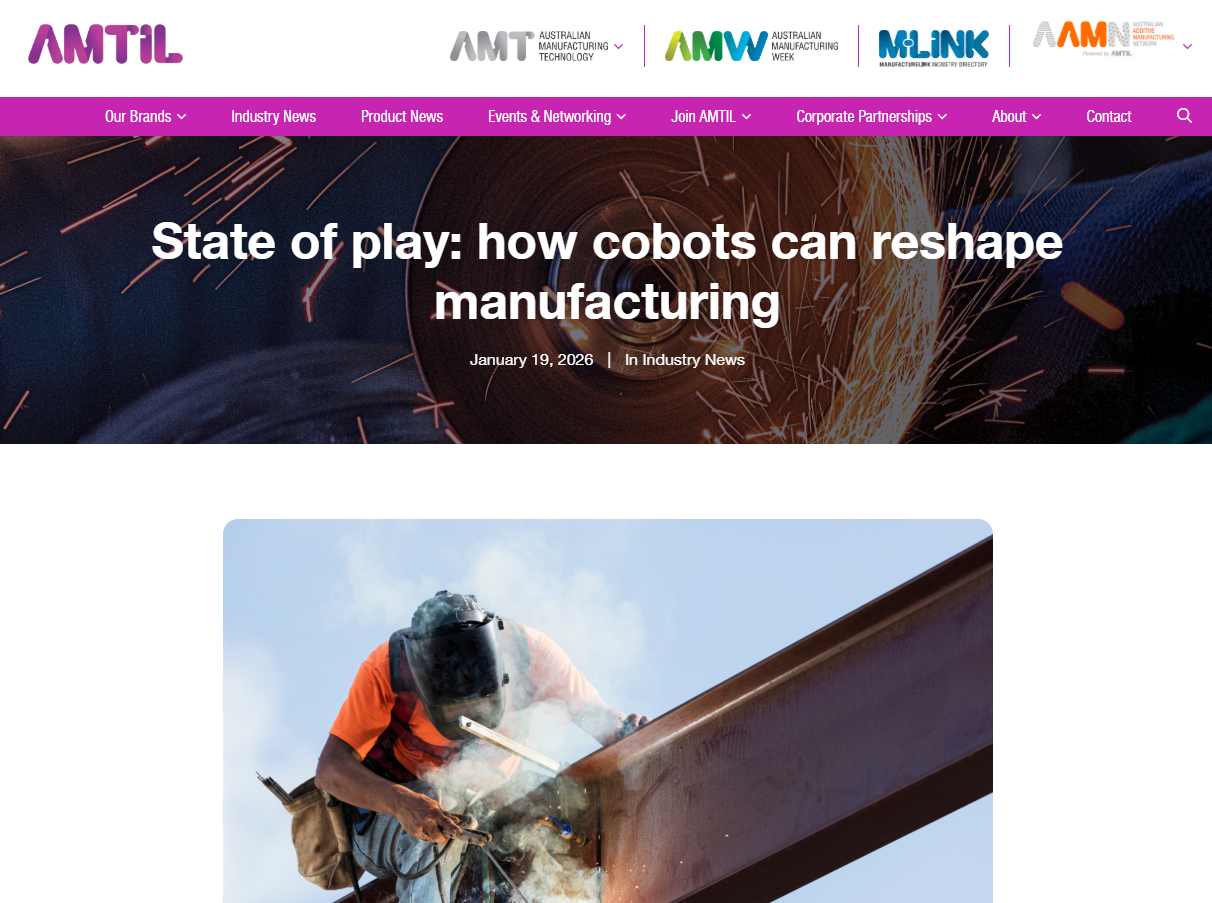
Deputy Director of the Australian Cobotics Centre & QUT Professor, Professor Glenda Caldwell, has been prominently featured in a recent AMTIL article exploring how Industry 5.0 is reshaping Australia’s manufacturing landscape. The piece highlights the growing importance of cobots as industry shifts toward more human‑centred, sustainable, and adaptable production systems.

In the article, Prof Caldwell explains that while Industry 4.0 focused heavily on technological advancement, Industry 5.0 calls for a deeper understanding of the human element—placing people, their needs, and their expertise at the centre of technology design and deployment. She emphasises that effective cobot integration begins with understanding the tasks workers perform, the environment they operate in, and the challenges they face.

The AMTIL article also notes the advantages of cobots, including built‑in safety sensors and the ability to work alongside people without traditional industrial barriers, making them more accessible to Australian manufacturers of all scales. Industry experts, including Weld Australia’s Dr Cornelius van Niekerk, reinforce how these features reduce infrastructure requirements while enhancing workplace safety.

Read more:
👉 AMTIL Article

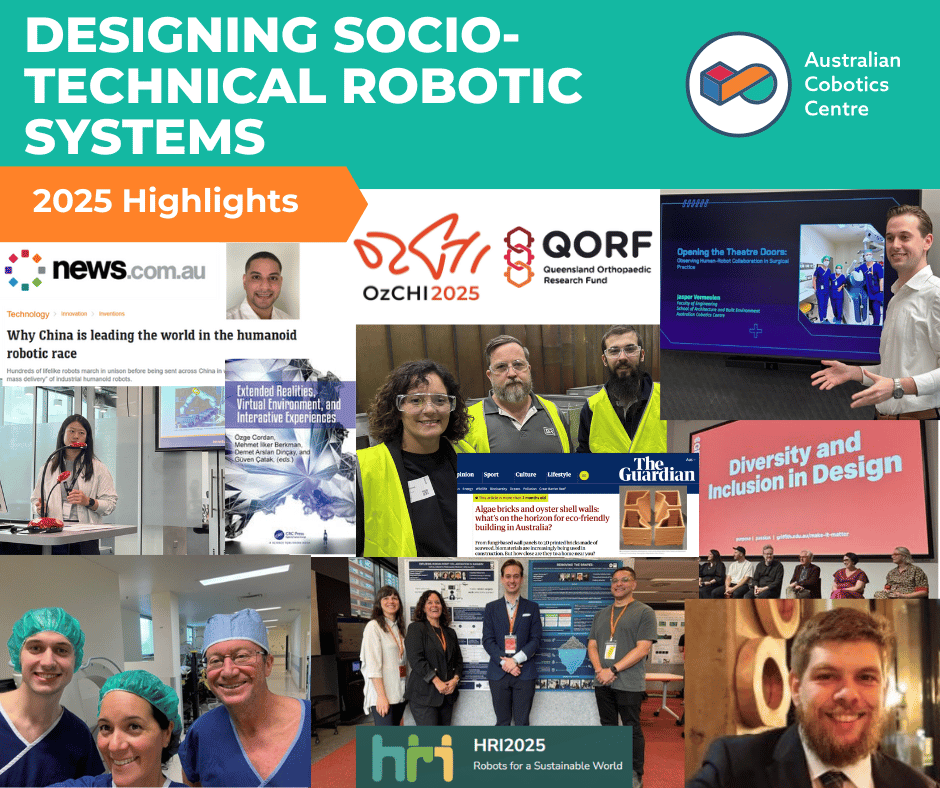
2025 in Review | Program 3 – Designing Socio‑Technical Robotic Systems

Continuing our 2025 program highlights, today we celebrate Program 3: Designing Socio‑Technical Robotic Systems led by A/Prof Müge Belek Fialho Teixeira and Dr Matthias Guertler, with postdoc Dr Alan Burden.

Here’s what stood out in 2025

  • Industry‑embedded research
    • Ongoing progress analysing Mako‑assisted surgeries, strengthening our evidence base for real‑world surgical HRC.
    • Expanded collaboration with B&R Enclosures, including commencement of a new proof‑of‑concept project.
    • a new University of Technology Sydney‑led socio‑technical cobot integration project that investigates the socio‑technical complexity of cobot workplaces to improve cobot selection and integration.
  • High‑impact research outputs
  • Media Mentions
  • Awards & recognition
    • Top 10 Cited Paper of 2024 (MDPI Robotics) — Yuan Liu
    • QUT Faculty of Engineering Best Poster Award — Yuan Liu
    • HDR Spotlight on Success Award — Jasper Vermeulen

Congratulations to the entire Program for another excellent year!

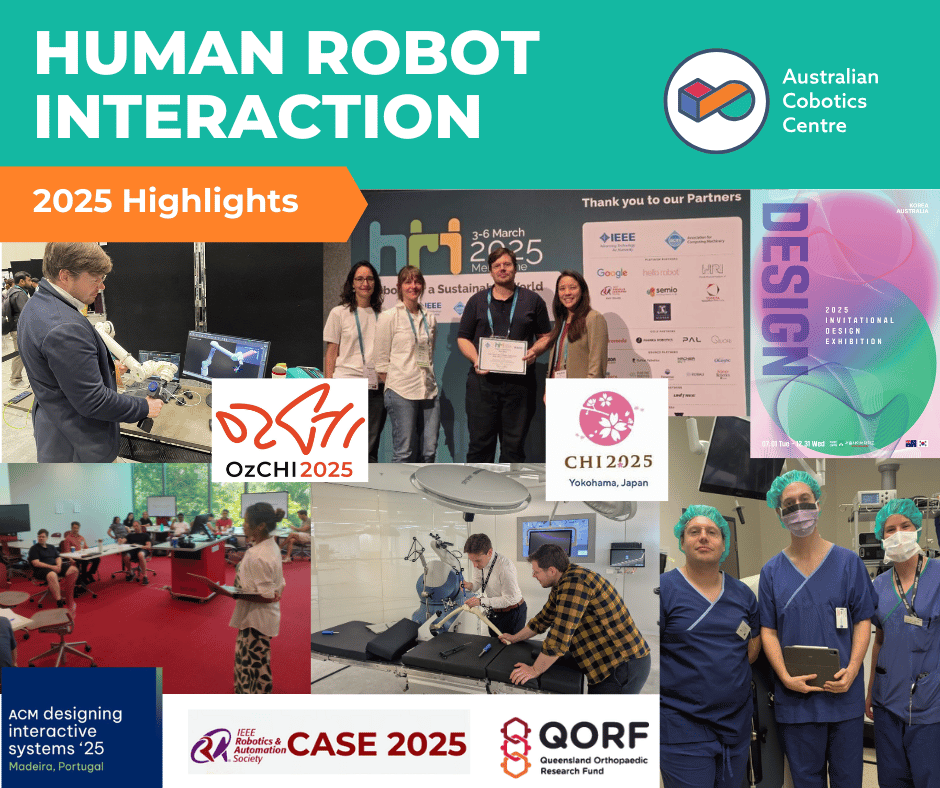
2025 in Review: Human-Robot Interaction Program

As we wrap up 2025, Program 2: Human–Robot Interaction (HRI) reflects on a year of strong collaboration, impactful research, and industry‑embedded outcomes that are shaping how humans and robots work together. The program led by Co-leads, Prof Markus Rittenbruch and A/Prof Jared Donovan with postdoc Dr Valeria Macalupú had an amazing year with:

  • Deep industry collaboration
    • The creation of an industry‑ready toolkit translating HRI insights into actionable design requirements collaborating with industry partners to test and validate the framework.
    • Continued collaboration with Cook Medical, including a PhD placement for James Dwyer.
    • Further development of tools initially created with one partner into assets used across multiple organisations and universities
  • Research excellence
    • 7 conference papers (DIS, CHI, HRI, IEEE CASE) and 5 journal publications, including Scientific Reports and Construction Robotics
    • Best Demo Award at HRI’25 for James Dwyer
    • Seed funding secured from the QUT Design Lab to launch new work on Design Affordances in HRI
  • New projects and methods
    • New Intention Visualisation research project led by Markus Rittenbruch with Research Assistant, Dr Wei Win Loy Ph.D.
    • Development of reflective and transferable research tools, including Visualising Your Research Positioning workshops, led by Dr Valeria Macalupú
    • Continued momentum on design‑led HRI methods that extend beyond the Centre’s lifespan
  • Cross‑university and cross‑disciplinary collaboration

Huge thanks to our researchers, HDRs, postdocs and industry partners for another year of thoughtful, human‑centred robotics research with real‑world impact.

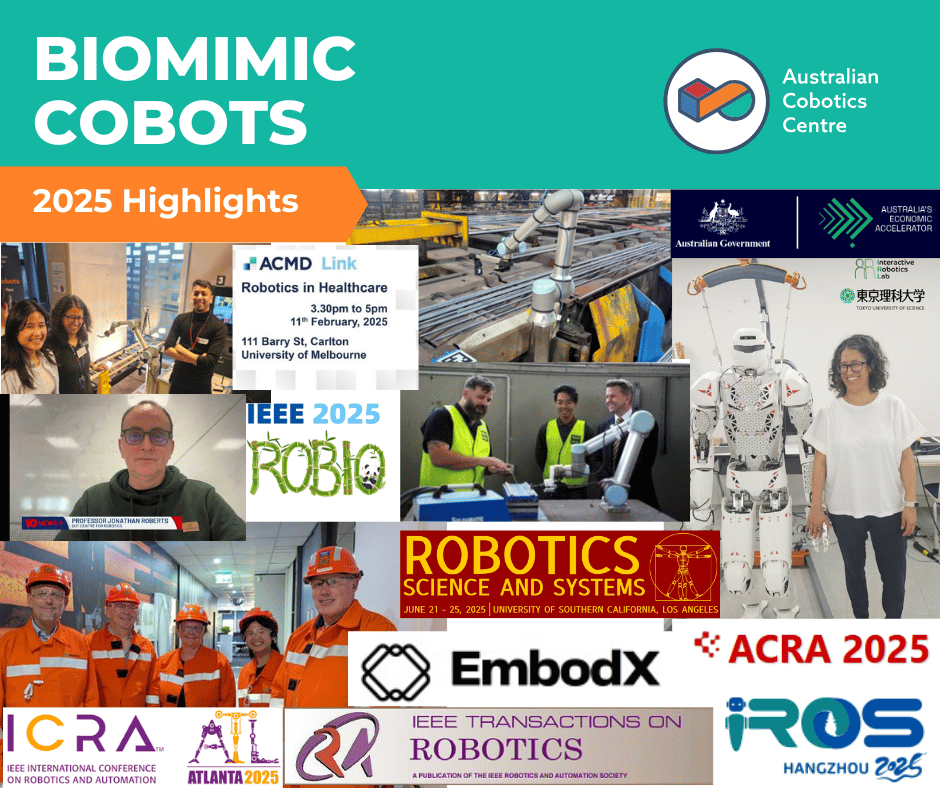
2025 Research Program Highlights – Biomimic Cobots

We’re kicking off our 2025 research program highlights with Program 1 – Biomimic Cobots, led by Prof Teresa Vidal Calleja (University of Technology Sydney) and Prof Mats Isaksson (Swinburne University of Technology) with postdoc Dr Sheila Sutjipto.

In 2025, the team delivered outstanding progress in enabling robots to perceive, learn, adapt and collaborate safely with humans, demonstrating what it takes to deploy advanced robotics “in the wild” in real industrial environments.

Here’s what stood out over the last year

  • Our continued collaboration with InfraBuild, culminated in the successful demonstration of an AI‑enabled “shorts” detection system operating on a live steel production line. This project demonstrated:
    • Real‑time quality inspection in a dynamic setting
    • Reduced waste through flexible, AI‑driven automation
    • Improved operator safety and reduced fatigue
  • The launch of EmbodX, founded by former ACC postdoc Dr Fouad (Fred) Sukkar. EmbodX is making AI‑powered robotics more accessible for SMEs, with ACC researchers Dr Sheila Sutjipto and Dr Tony Le also on the team
  • Research excellence across perception, sensing and learning
    • Publications across IEEE CASE, ROBIO, HRI, RA‑L, TRO and RSS, including outputs led by PhD researchers Jagannatha Charjee Pyaraka and Nadimul Haque
    • Innovative low‑cost solutions emerging from biomimetic research, including audio‑based sensing approaches validated in industrial contexts
    • Recognition of the difficulty — and value — of conducting high‑quality research directly on factory floors
  • Collaboration across Australia and internationally
    •  Strong cross‑university collaboration between UTS, Swinburne and QUT
    • New academic collaborations, with Prof Teresa Vidal‑Calleja and Dr Sheila Sutjipto in Japan collaborating with Tokyo University of Science and others
    • Hands‑on engagement through workshops, demos and showcases across Australia and internationally, led by HDRs, postdocs and CIs including Swinburne University of Technology‘s Industry 4.0 workshops, demonstrations for MPs (Zongyuan Zhang, Jonathan Roberts), and countless industry visits.

Congratulations to the entire Biomimic Cobots team for an exceptional year of research excellence and real‑world impact. We can’t wait to see what 2026 brings.