


POSTED: 25 Mar, 2024
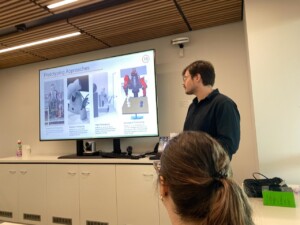
We extend our congratulations to James Dwyer, our PhD researcher, for successfully completing his confirmation seminar on March 20th.
James’s thesis, titled “How Can We Design for Human-Robot Collaboration: the Need for a Human-Robot Collaboration Prototyping Toolkit,” is under the supervision of Jared Donovan, Markus Rittenbruch, Stine Johansen and Rafael Gomez FDIA from QUT (Queensland University of Technology) and the review panel included Marianella Chamorro-Koc and Claire Brophy.
His project is dedicated to developing a human robot collaboration Prototyping Toolkit that integrates both physical and simulated robotic systems. This initiative aims to streamline the exploration, development, and testing of novel processes and work routines. Through a collaboration with industry partner Cook Medical, the research team will explore various prototyping techniques and utilise advanced technologies such as motion tracking, mixed-reality interfaces, and lightweight interactive components to safely explore new interaction concepts.
This innovative approach promises to equip designers, engineers, and end-users with the essential resources for enhancing future human-robot collaboration within the manufacturing landscape.
For more details about James’s project, please see: Project 2.2: Human Robotic Interaction prototyping toolkit » Australian Cobotics Centre | ARC funded ITTC for Collaborative Robotics in Advanced Manufacturing
Recent News
Humanoid Robotics in the Spotlight: Australian Cobotics Centre Researchers Share Expertise with National Audiences
Humanoid Robotics in the Spotlight: Australian Cobotics Centre Researchers Share Expertise with National Audiences Humanoid robotics has captured ...
What is Mathematical Optimisation Actually Doing? A Physical Picture of Finding the Shortest Distance Between Shapes
Written by Louis Fernandez, PhD Researcher, based at UTS and part of the Human-Robot Interaction program. Mathematical optimisation often comes acros ...
MegaTrans 2026: Where Robotics Meets the Future of Logistics
MegaTrans 2026: Where Robotics Meets the Future of Logistics As Australia's freight, warehousing and logistics sectors face growing pressure to imp ...