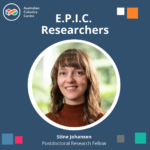
 Dr Stine Johansen joined the Australian Cobotics Centre in June 2022 as a Postdoctoral Research Fellow in the Human-Robot Interaction (HRI) Program, working with Professor Markus Rittenbruch and Professor Jared Donovan.
During her time with the Centre, Stine explored how robotic systems can be effectively integrated into existing work practices, helping industry partners capture and apply worker expertise in the design of future robotic systems. Her research also examined how robots communicate intent, with a particular focus on the role of sound in human-robot interaction.
After completing her role with the Centre in December 2024, Stine returned to her native Denmark. She is now a Tenure-Track Assistant Professor at Aalborg University, where she co-leads a strategic research initiative exploring human-robot collaboration in healthcare settings while continuing research into how people interact with cyber-physical systems.
As part of our EPIC Experiences series, we’re catching up with former team members to learn where their careers have taken them, how their time at the Centre shaped their journey, and what advice they have for the next generation of researchers.
1. Where are you now, and what does your current role involve?
Since January 2025, I have been employed as Tenure-Track Assistant Professor at the Department of Computer Science, Aalborg University, Denmark. On the research side, I co-lead a strategic faculty initiative on robotics in healthcare where we collaborate with hospital and other clinical environments on what it takes to establish sustainable and useful human-robot collaboration in healthcare practices. In parallel to that, I am interested in the roles of sound in people’s interactions with cyber-physical systems. I also teach courses on designing and programming interfaces as well as design thinking.
2. What was the focus of your research at the Centre?
My research at the centre had two key focus areas. First, I focused on early-stage design of robotic systems and integration of such systems into existing work practices. Together with our industry partners, we investigated ways to elicit the expert knowledge of people who will eventually use robotic systems in their work. Second, I focused on intention visualization, i.e., how robots can communicate internal states and intended actions. I was mainly concerned with the role sound plays in human-robot interaction and in finding ways to capture people’s experiences of robot sounds. Our team collaborated with two fantastic sound designers, and we designed and exhibited a robot movement sonification system.
3. One lesson from working with industry that has stayed with you
I really appreciated developing projects in collaboration with our industry partners from the start. I think that process made the projects more relevant to both research and applications outside of the projects themselves. We all want our collaborative efforts to result in valuable outcomes and, while it takes time to develop project ideas across institutions and disciplines, it really helps for everyone to have a sense of ownership of the project.
4. How did your time at the Centre influence your career path?
I hadn’t done research relating to robotics before joining the centre, so I would say it had a crucial impact on the trajectory of my research. It also gave me experience across multiple research labs in a highly international environment. From that, I’m taking many lessons with me on interdisciplinary research projects.
5. Most rewarding part of your career since leaving?
I enjoy many aspects of my work, but one very rewarding part since leaving the ACC has been to establish and co-lead a research initiative at Aalborg University on human-robot collaboration in healthcare. It has been very exciting to take learnings from our research in Australia and see how they can be used in Danish environments.
6. Advice for current HDRs
I enjoy many aspects of my work, but one very rewarding part since leaving the ACC has been to establish and co-lead a research initiative at Aalborg University on human-robot collaboration in healthcare. It has been very exciting to take learnings from our research in Australia and see how they can be used in Danish environments.


